

SEO y GEO: qué está cambiando realmente en el posicionamiento de una marca
Publicado: 4 de September de 2026 · Actualizado: 4 de September de 2026
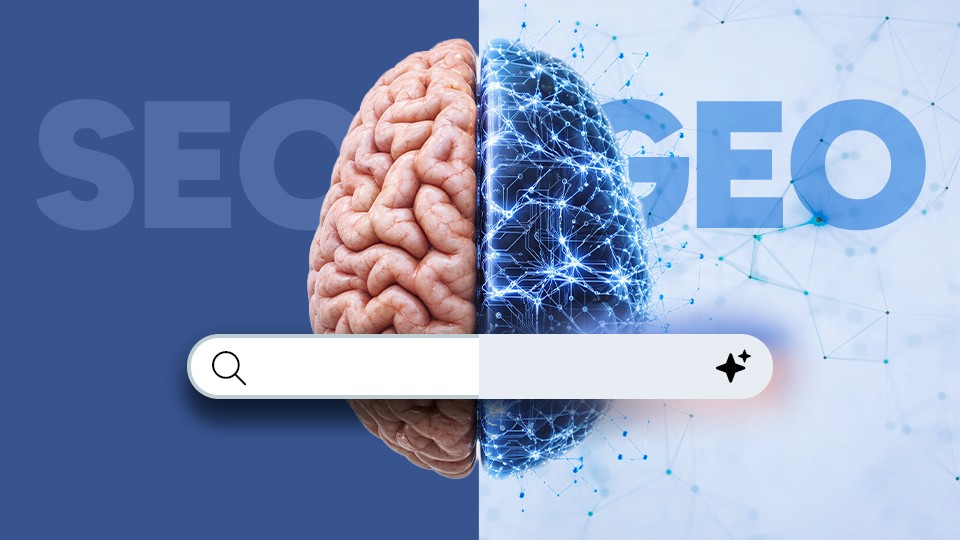
SEO and GEO (Generative Engine Optimization) they are not opposing disciplines: GEO extends the logic of positioning to a scenario where an increasing number of searches culminate in an AI-generated answer rather than a list of links. Before diving into the details, here is what is truly changing and what remains just as important.
In summary
- GEO does not replace SEO; it expands our understanding of positioning.
- Generative search no longer rewards only well-optimized pages, but rather brands recognized as reliable sources.
- Publishing a lot of content ceases to be an advantage if it does not contribute original insights.
- SEO, communication, reputation, and brand increasingly converge in the way AI interprets an organization.
- The challenge is no longer just being visible; it is being considered a citable source.
In digital marketing, we have a knack for coining a new acronym whenever the market changes. Over the last few months, we have added terms to our vocabulary such as GEO, AEO, LLMO o AI Search Optimization to explain how brands should position themselves in an environment where an increasing number of searches end with an answer generated by artificial intelligence.
These terms can be useful for naming new phenomena, but the problem arises when we mistake a change in terminology for a complete change in the rules of the game. Underlying much of this conversation are familiar questions: whether a brand has something relevant to say about a specific area; whether there is enough information to understand who it is, what it does, and why it can be considered a reliable source; whether others are talking about it; whether its expertise is recognized outside its own channels; and whether its content offers something beyond merely repeating what already exists.
All of that was already important for SEO. In the new landscape, it is even more so.
What exactly is changing in the way we search?
For years, we understood search in relatively simple terms: a person would enter a query, and the search engine would return a list of results. To put it very simply, the goal of an SEO strategy was to get a page to appear as high up as possible on that list and ensure it was relevant enough to attract a click.
On Generative search changes that dynamic.Users no longer receive merely links; increasingly, they receive a response constructed from various sources, in which the system interprets the query, locates information, compares, synthesizes, and—in some cases—recommends options. This means we are no longer competing solely for a position on a results page, but also to be part of the set of sources and signals that enable the system to construct a response with a certain level of confidence.
The difference may seem small, but it is strategically significant: getting a page found is one thing, but getting a brand, an organization, or an expert considered relevant and trustworthy enough to be part of the answer is quite another.
GEO does not replace SEO; it expands our understanding of positioning.
Sometimes GEO is presented as if everything learned about positioning has become useless, when In reality, many of the fundamentals remain the same. A technically sound website remains necessary, understandable information architecture continues to hold value, useful content remains a decisive factor, and elements such as authority, external mentions, links, user experience, and the ability to address search intent continue to be part of the equation.
What changes is that a new requirement emerges on that foundation. While traditional search could highly reward a specific page, generative systems also need to understand the entity behind that page, its relationship to a particular topic, the level of recognition it has built, and the signals existing outside its own assets that justify its trustworthiness.
That is why it is more useful to view GEO as an evolution of positioning rather than as an independent discipline: it does not replace the previous logic but compels it to broaden its focus.
An AI needs to understand who you are before considering you a reference.
Companies tend to view their digital presence in terms of their own assets—websites, blogs, social media profiles, proprietary content, and, in general, whatever is directly within their control. However, an artificial intelligence does not build its representation of a company solely based on what that company says about itself, but rather from a much broader ecosystem involving signals such as:
- media and specialized press
- specialists and leading voices in the sector
- associations and entities in the field
- clients and case studies
- opinions, interviews, and external publications
The system attempts to understand the position that organization occupies within a specific context, its relationship with certain concepts, and the extent of the consistency between what the company claims to be and what the rest of the digital ecosystem confirms about it.
Here, positioning aligns much more closely with concepts traditionally linked to reputation: it is no longer enough to simply declare that an organization is an expert in a particular field; there must be sufficient digital evidence for third parties—and increasingly, AI systems as well—to reach that conclusion.
Publishing a lot of content no longer equates to building authority.
At one stage in the evolution of SEO, a simple logic prevailed: the more questions related to a category we could answer, the greater our ability to capture search traffic. This gave rise to massive content strategies—packed with glossaries, guides, FAQs, and articles—aimed at covering virtually every possible variation of a keyword.
Much of that content remains useful, but the ease with which generic information can be produced today compels us to re-evaluate its value. If artificial intelligence can generate a competent text on almost any subject in seconds, publishing yet another competent piece of content is no longer necessarily a competitive advantage. The question then becomes something else:
- What do we know that not everyone else knows?
- What personal experience can we contribute?
- What data and cases have we accumulated?
- What knowledge is actually gained from working in this activity?
- What perspective can we offer that is not interchangeable with that of any other actor?
Content remains fundamental, but its role is shifting: it is no longer about covering keywords or increasing editorial volume, but rather demonstrating knowledge, expertise, and a genuine ability to offer something worthy of serving as a reference.
SEO, communication, reputation, and branding are beginning to converge.
This is one of the most interesting shifts for organizations, because for years we have handled these disciplines within largely separate structures: SEO managed search rankings, communications sought media presence, social media generated conversation, branding built awareness and meaning, and content fueled the various channels with specific objectives.
From the perspective of an artificial intelligence system, those boundaries make considerably less sense. An interview in a specialized outlet can reinforce a company’s authority, original research can become a source, an expert’s public appearance can help associate a brand with a specific area of knowledge, and a well-crafted public relations strategy can ultimately influence how an organization is interpreted digitally.
This does not mean that every discipline is now SEO, nor that we should force their integration under a single label. It means something simpler: building digital authority is becoming increasingly cross-functional, and many signals we once managed independently are beginning to converge into the overall representation that systems construct of a brand.
The challenge is no longer just to be visible, but to be a citable source.
For a long time, we have worked to ensure a brand is visible when someone performs a search. That objective still makes sense, but it is beginning to coexist with a more demanding one: ensuring the brand is considered relevant enough to be part of an answer generated by artificial intelligence.
Achieving that requires more than just a well-optimized page: it demands recognition, consistency, specialization, evidence, reputation, and a clear connection between the brand and the subject matter over which it claims authority. None of this replaces the technical work of SEO; rather, it expands upon it, compelling us to view positioning through a lens far more closely aligned with brand building.
What we still don't know about this scenario
It is wise to exercise a degree of caution, given that we are dealing with rapidly changing technologies and that models, search interfaces, and user habits will continue to evolve. Claiming that a fixed, definitive methodology for "positioning oneself in AI" exists today would be an overstatement—especially when we are still learning which sources different models use, how responses vary, the weight of specific mentions, and how to accurately measure a brand's presence in these environments.
That is why it likely makes more sense to reinforce fundamentals that will remain useful—rather than chasing every new tactic that emerges—by building an understandable website, generating useful knowledge, creating content that addresses real needs, developing recognizable specialists, establishing a presence in relevant sources, and maintaining a clear, consistent identity across the entire digital ecosystem.
Frequently Asked Questions about SEO and GEO
What is GEO (Generative Engine Optimization)?
GEO encompasses the practices aimed at ensuring a brand, its data, and its knowledge are taken into account by artificial intelligence systems that construct answers from multiple sources, rather than simply displaying a list of links.
Is GEO replacing SEO?
No. GEO extends the logic of traditional SEO: the technical foundation, useful content, and user experience remain essential, but they are coupled with the requirement that AI be able to identify the brand as a reliable source on a specific topic.
How does generative search affect a brand's positioning?
Generative search is no longer limited to ranking pages; it interprets the query, compares various sources, and synthesizes an answer. This means brands compete not only for a position in the results but also to be part of the set of sources the system uses to construct that answer.
What does a brand need for AI to consider it a reliable source?
It requires consistent digital evidence: original content demonstrating genuine expertise, external mentions, a presence in media and specialized sources, and an identity that is coherent—aligning what the brand claims to be with what the rest of the digital ecosystem confirms about it.
Our approach to SEO and GEO at PRISMA
In PRISMA We view this evolution as one that is not particularly revolutionary in its formulation, yet profound in its consequences. SEO remains necessary, GEO introduces new variables, and artificial intelligence is significantly altering how people access information. Yet, underlying all these transformations, a fundamental principle remains: brands possessing greater knowledge, authority, recognition, and digital evidence to substantiate their claims will be more likely to feature in the answers provided.
We might call that work SEO, GEO, AEO, or something else a few months from now, but Nomenclature matters far less than understanding the principle.For years, we worked to ensure search engines found our pages; now, we also need to get machines to understand our brands—and understanding a brand is far more complex than finding a keyword.
We also want to share with you...
MIG PRISMA estrena nueva sede en Madrid para impulsar su evolución hacia un modelo de agencia IA Powered
Nueva casa para una nueva forma de hacer agencia
Share of Answer: qué mide y por qué empieza a ser relevante para la visibilidad de las marcas en IA
MIG PRISMA joins Cantabria Labs in Santander to amplify the "Zero Melanoma" initiative.
