

Speech about Speech
Publicado: 29 de April de 2024 · Actualizado: 29 de April de 2024
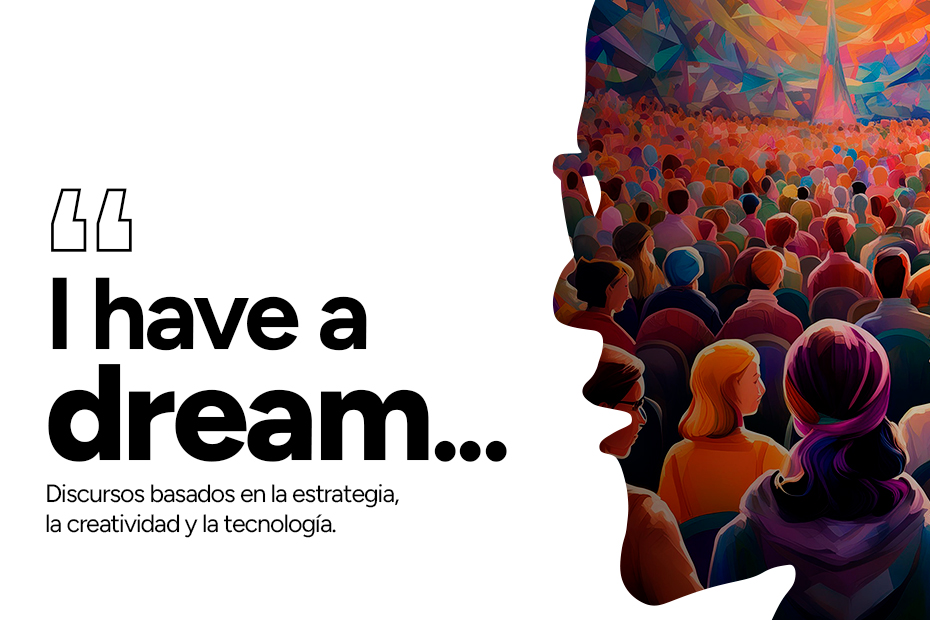
I've just read one of the latest entries on this blog, in which our company explains its rebranding, and synthesizes its value proposition around these axes: Strategy, creativity and technology. Something that embodies our new claim very well, HumAIn Power. Because, yes, in MIG Prisma Let's combine human talent with emerging technologies.
You'll read this and think... these are words everyone says about themselves these days, a speech, a narrative, to jump on the bandwagon. Well, no, they are not empty words. We are what we say we are. And I'm going to prove it! Here's an example...
I'm part of the agency's Communication, Content and Conversation team. They say I don't write badly. Or that I write well. Depends on who you ask. I've written well since I was a child. The teachers told me so. And I won prizes at school (though never first prize…). Is that talent? It could be... I also put it down to reading a lot... But also, to studying...
I studied journalism. It's a matter of vocation. And that's where I learned to write better. Better, yes, because I learned to do it in a way that achieved a goal. Is that strategy? Yes, I learned that strategic character, for example, in Political Communications., when it comes to writing speeches.
I had one of those classes that really stays with you. And that ‘almost historical’ memory – we're talking about 20 years ago now – has helped me a lot in my professional life. I've written more than one speech! And thanks to that class, I've always done it with purpose., pursuing a goal: for my message to resonate with the majority of the audience, even to convince them.
And what is that strategic knowledge that I learned? Crafting speeches from Carl Jung's theory of psychological types. Jung proposed that people have different ways of perceiving the world and processing information, and developed a personality typology based on these differences. This typology is composed of four main functions: Thought, feeling, sensation and intuition, and each individual tends to prefer one or two of these functions.
This way, if you head towards a diverse audience, made up of people who consider all psychological types, and you use resources that appeal to each of them in your speech, Your message will resonate with a wide spectrum. of that audience.
Likewise, if you are heading to a homogeneous audience, comprising people of the same psychological type, scientists (type of thinking), for example, do not use discursive resources that appeal to sentimental matters.
Let's delve into it...
When the theory of psychological types is applied to speech construction, it considers how different personality types can influence the way people communicate and how they receive information. For example:
- Thought (T)People who prefer this function tend to be logical and rational in their approach. The discourse that reaches them will be one that presents arguments structured logically, using evidence and reasoning to back up their points.
- FeelingThose who prefer this function tend to make decisions based on their values and emotions. How should we address them in a speech? By appealing to the audience's emotions, sharing personal stories, and focusing on how people feel about a topic rather than simply presenting objective data.
- Sensation (S)People with this preference tend to be detail-oriented and practical. In speeches, let's provide them with concrete examples and specific details to back up our arguments, focusing on sensory experience and what can be observed and measured.
- Intuition (N)Those who prefer this function tend to be imaginative and future-oriented. The discourse they gravitate towards is one that presents abstract ideas and theories, making connections between different concepts and proposing innovative possibilities and solutions.
This is how I learned that when writing a speech, it should be adapted to meet the needs and preferences of different types of audiences, using an approach that resonates with their preferred information processing style. For example, it can include rational elements for those who prefer thinking, emotional anecdotes for those who prefer feeling, concrete examples for those who prefer sensing, and innovative ideas for those who prefer intuition.
Knowing this, I've worked in the Corporate Communications departments of various companies and agencies. And I have written speeches with this strategic orientation.
Here at MIG Prisma, too. But here, with a little extra., given in recent years by technology. And that's because, yes, I have used artificial intelligence tools which, combined with my creative talent and the strategic sense learned at university, have helped me to expand and refine those discursive resources what I've included in my rhetoric when addressing a particular audience.
Because yes, ChatGPT or other generative AI tools do help with writing speeches, but It's not a matter of going to OpenAI and asking ChatGPT to write you a speech... No!
At MIG Prisma, what we do is utilising technological tools strategically, which help us to refine our creativity and talent for the achievement of a communication objective.
This is how we communicate, transmit and convince. Do you want this virtuous triangle (strategy, creative talent and technology) for your company or brand's communication? Attend the vertices of our Prism.
Let's talk!
We also want to share with you...
MIG PRISMA estrena nueva sede en Madrid para impulsar su evolución hacia un modelo de agencia IA Powered
Nueva casa para una nueva forma de hacer agencia
Share of Answer: qué mide y por qué empieza a ser relevante para la visibilidad de las marcas en IA
MIG PRISMA joins Cantabria Labs in Santander to amplify the "Zero Melanoma" initiative.
