
“Extended Wellbeing 2040” Report: The first major milestone in our collaboration with Santalucía Espacio Futuro
Publicado: 26 de February de 2026 · Actualizado: 26 de February de 2026
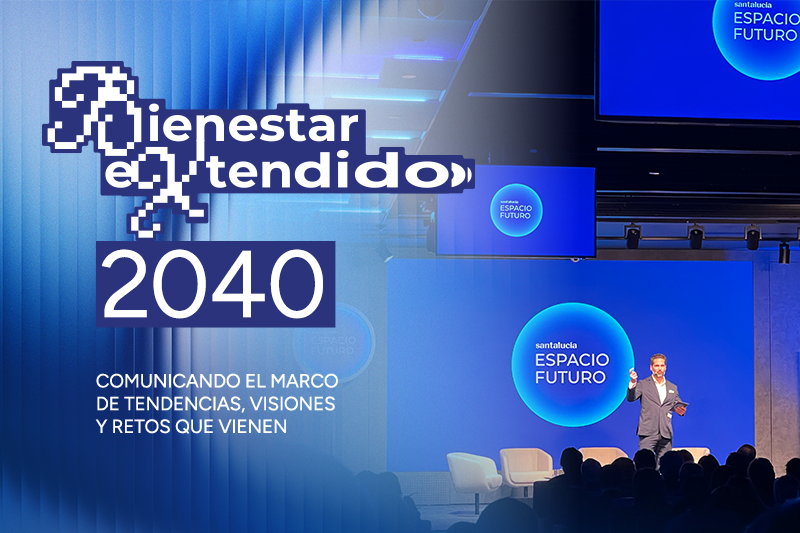
Last Tuesday the 24th saw the culmination of one of the first milestones in our collaboration with Santalucía Future Space. Having been awarded the account in 2025, the project launched with a challenge as demanding as it was stimulating: to accompany the public launch of the “Extended Wellbeing 2040” report and turn it into a genuine starting point for social conversation, rather than just another document.
At a time when almost everything is communicated at headline speed, the corporate think tanks they perform a particularly valuable function: ordering complexity, translating it, and sustaining public discourse with rigour. A think tank is not a media outlet, nor is it a campaign. It is an instrument of applied knowledge. It observes, researches, contrasts, synthesises and, above all, proposes frameworks for interpreting changes that are not always foreseen, but which are already impacting how we live, work, care for ourselves, and make decisions. On that border, between what is happening and what is to come, operates Santalucía Espacio Futuro.
From the outset, it was clear to us that this launch could not be approached with a conventional strategy. The challenge was specific: for the first time, to aim the report at an external impact capable of conveying Espacio Futuro's work and its contribution to an essential idea to society as a whole: in contexts of accelerated transformation, better decision-making requires better understanding. And better understanding requires interpretive frameworks that allow us to distinguish relevant signals, read emerging tensions, and anticipate implications for daily life.
The Extended Well-being Report“ stems precisely from this need. Faced with reductionist interpretations of well-being, understood as an individual state, a set of habits, or an aspirational promise, the report proposes a broader perspective: well-being as a system. A system in which social and cultural changes, technological acceleration, economic pressures, life expectations, new forms of relationships, and increasing demands for trust and regulation interact. In practice, this means that simply talking about well-being is no longer enough: we must be able to explain which well-being we are talking about, what conditions it, what deteriorates it, and what decisions protect or improve it.
Our contribution to the project was built from that premise: If well-being is a system, communication cannot be limited to just “disseminating” conclusions. The framework has to be made legible, transferable to diverse audiences, and relevant to social debate. We are therefore working in two complementary directions: on the one hand, the construction of a public territory and a coherent narrative with the think tank's ambition; on the other, the design of an activation capable of taking the report where it ought to be: within the ecosystem and on the media agenda.
In that sense, the role of the media was a central lever, not as a tactical objective, but as part of the purpose: to broaden the reach of an interpretative framework that aims to be useful. And, in parallel, relationships with the ecosystem – relevant entities, collectives, and actors – were conceived as the second vector of impact: building community around knowledge. When a project is born to help guide decisions and improve public understanding, it is measured not only by immediate visibility, but by its capacity to activate connections, conversations, and continuity.
Yesterday's milestone is important for what it represents: the public launch of a project that aims to be sustainable over time. But it is also important for what it confirms: that organisations committed to future thinking have an additional responsibility. It is not enough to “have content”. It must be made accessible without losing rigour, and it must be given a communication architecture that allows this knowledge to be truly useful for decision-makers, for influencers, and for those who experience the consequences of the changes we analyse in the first person.
To find out more about Santalucía Espacio Futuro and access its content, visit the website: Santalucía Future Space.
We also want to share with you...
MIG PRISMA estrena nueva sede en Madrid para impulsar su evolución hacia un modelo de agencia IA Powered
Nueva casa para una nueva forma de hacer agencia
Share of Answer: qué mide y por qué empieza a ser relevante para la visibilidad de las marcas en IA
MIG PRISMA joins Cantabria Labs in Santander to amplify the "Zero Melanoma" initiative.
