
Technology, business, and people: the balance that will decide true transformation
Publicado: 18 de June de 2026 · Actualizado: 18 de June de 2026
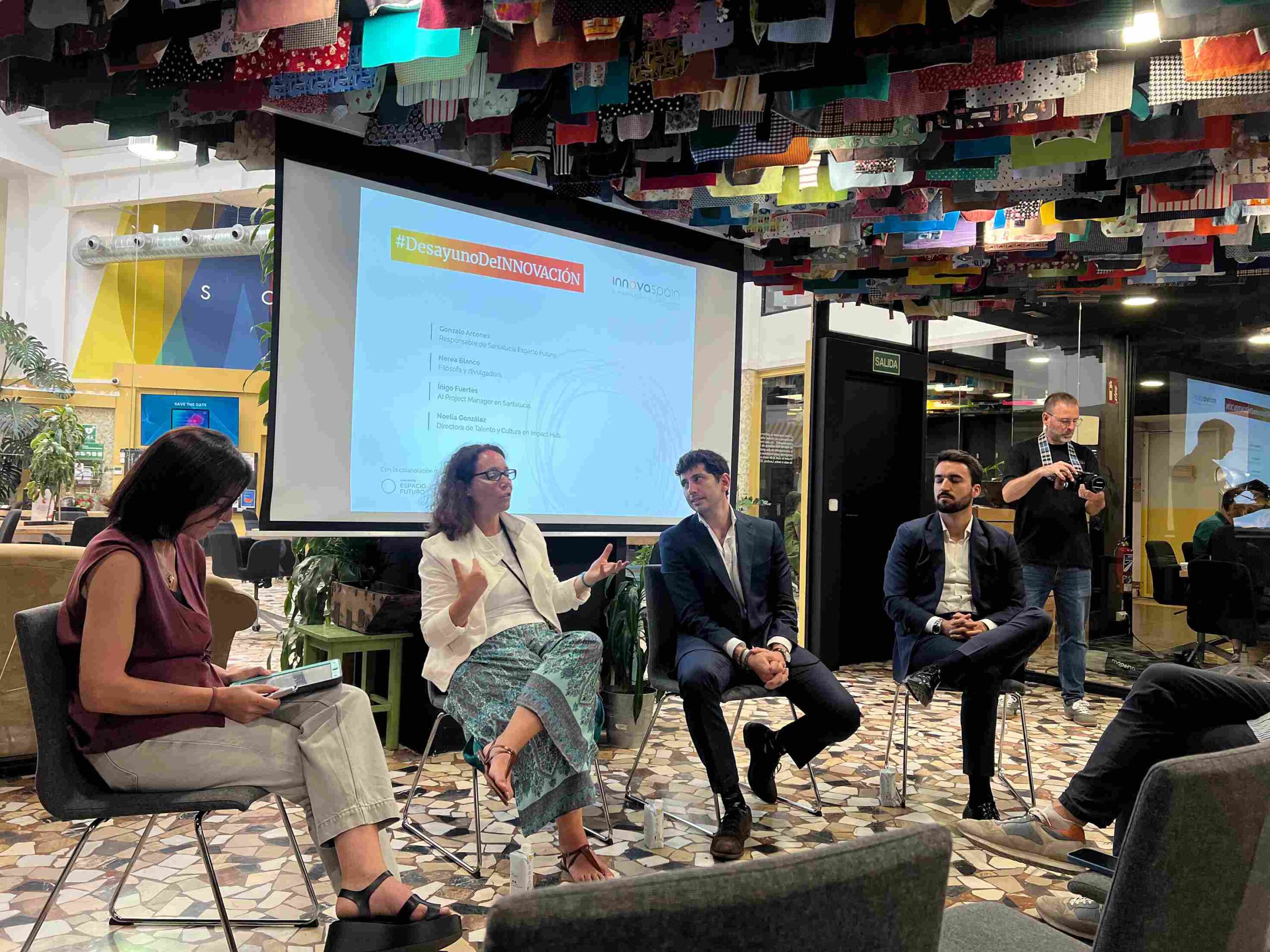
Taking advantage of the presence of David Galán, CEO and co-founder of MIG, at the meeting organised by Future Space e InnovaSpain under the title “The new balance between technology, business, and people”, We want to pause and reflect on something that is becoming increasingly relevant for organisations.
For years, a significant part of the transformation discourse has tended to simplify the issue: incorporating technology was, almost by itself, equivalent to modernising a company. However, reality has dismantled that idea quite forcefully.
Technology, in itself, transforms nothing.
It transforms when it finds an organisation that is culturally ready to integrate it. When there is a leadership capable of translating it into better decisions. When people understand what is changing, why it is changing, and what new capabilities that change demands. And, above all, when the business is capable of incorporating that evolution without losing meaning, direction, or coherence.
Transformation is buying technology
Part of the problem has been confusing technological adoption with real transformation. Many organisations have invested for years in new tools, new platforms or new processes without truly addressing the most important question: whether the company's culture was ready to absorb that change and turn it into impact.
The consequence we know well is: underutilised technologies, teams that don't quite incorporate them into their real working dynamic, and initiatives that improve things superficially but don't substantially alter how decisions are made, how people collaborate, how priorities are set, or how value is created.
Transformation doesn't happen when an organisation buys technology. It happens when it is able to reorganise itself around it with intelligence, judgement and purpose.
Technology Speed Vs. Human Speed
Technology is advancing at an enormous speed. Automation, analysis, prediction, and generation capabilities are multiplying. Adoption cycles are shortening. Business models are rapidly reconfiguring. Competitive rules are changing before many organisations have finished understanding the previous change.
However, humans don't evolve at that speed. We don't learn, unlearn, internalise, or reorganise ourselves at the same pace as tools advance. And that gap is, today, one of the main points of tension in any organisation that truly wants to transform.
The important question is no longer just which technologies we should incorporate. The question is whether we will have enough resilience, maturity and flexibility to adapt to the speed that these times demand of us.
Human capabilities
Therefore, in this context, it is advisable to shift the focus. The debate on transformation can no longer remain at the level of tools. It must move towards the capabilities that people and organisations need to develop to live with an environment of permanent change.
Among them, there are some that seem especially important:
Learning and unlearning ability.
It's no longer enough to incorporate new knowledge. It will become increasingly important to let go of mental frameworks, habits, and certainties that are no longer useful.
Pensamiento crítico.
In an environment saturated with information, automation, and speed, true value will not lie solely in accessing answers, but in formulating better questions, interpreting context more effectively, and discerning with judgement.
Systemic reading.
Technology doesn't just affect isolated processes. It reconfigures relationships, structures, decision-making models, customer expectations, and internal culture. Understanding this interdependence will become increasingly important.
Emotional maturity.
Transformation implies living with uncertainty, ambiguity, and a sense of impermanence. Emotional management of change will cease to be a peripheral competence.
Ethical criterion.
The more power technologies have to intervene in reality, the more crucial it will be to define through which principles we want to apply them.
Professional model, societal model
When we talk about the balance between technology, business, and people, we aren't just talking about organisational efficiency. We are also talking about the type of professional and the type of society we are helping to build.
Because not all acceleration is progress. Not all efficiency is improvement. Not all technological capability automatically generates a more habitable, more intelligent, or more human environment.
We have moved from more visible forms of external exploitation to much more sophisticated forms of self-exploitation. The contemporary professional no longer lives solely under the pressure of a system that demands from them. They also live by internalising that demand, turning it into their own dynamic: more performance, more updating, more availability, more adaptation, more productivity.
And this has consequences. If we don't think through this moment carefully, we run the risk of building technologically advanced but humanly exhausted organisations. Organisations capable of incorporating increasingly sophisticated tools, but increasingly less capable of sustaining healthy contexts for people to think, learn, decide and add value without breaking in the process.
Critical thinking as a competitive advantage
Therefore, one of the most important competitive factors at this stage will probably not just be technological adoption. It will be critical thinking: the ability to interpret reality well, to connect technology with purpose, to distinguish between speed and direction, to decide what should be automated and what should not, to understand what is changing in the business and what is changing in the culture, and to maintain judgment amidst acceleration.
And that also forces us to rethink leadership. Because leading at this stage will not just consist of fostering innovation, but of doing so without hollowing out the organisation's meaning, without breaking its human balance, and without losing sight that real transformation does not only happen in systems, but in people.
One of the greatest successes of events like the one organised by Espacio Futuro and InnovaSpain is precisely that: opening up spaces that escape short-termism and that do not reduce innovation to headlines, tools, or superficial promises.
Spaces where the conversation doesn't just revolve around what technology is coming, but around what we do with it, from what culture, with what capabilities, and in service of what kind of organisation and society.
In MIG PRISMA We believe that this type of reflection should not be exceptional. It should be part of the normal functioning of organisations that want to transform themselves intelligently.
Because true innovation isn't just about incorporating technology. It's about how that technology changes the way we work, decide, collaborate, and build trust.
We also want to share with you...
MIG PRISMA estrena nueva sede en Madrid para impulsar su evolución hacia un modelo de agencia IA Powered
Nueva casa para una nueva forma de hacer agencia
Share of Answer: qué mide y por qué empieza a ser relevante para la visibilidad de las marcas en IA
MIG PRISMA joins Cantabria Labs in Santander to amplify the "Zero Melanoma" initiative.
