
Marketing in 2026: less expansion, more discernment
Publicado: 26 de January de 2026 · Actualizado: 26 de January de 2026
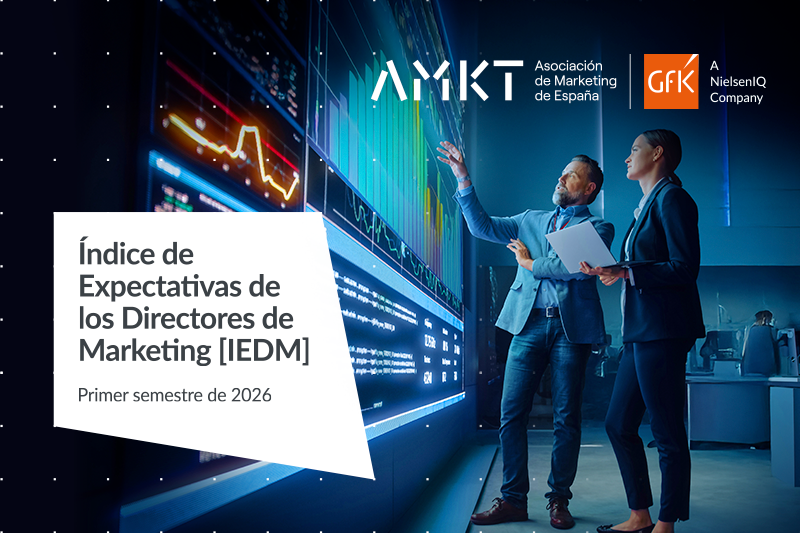
Every start of the year, the sector is filled with reports, forecasts and trends. Some aim to anticipate the future; others help to better understand the present. Marketing Directors' Expectations Index, produced in Spain by GfK in conjunction with the Marketing Association of Spain, clearly belongs to this second group.
Not because it announces great disruptions, but because it puts figures, context and order to many of the tensions that brands are already experiencing: more contained growth, greater pressure on profitability and a growing demand for the real role of marketing in the business.
Less margin for error
The study reflects that a majority of companies closed 2025 having met or even exceeded their objectives. At first glance, this data could be interpreted positively. However, it coexists with a significant level of caution among marketing directors, who anticipate a more complex environment for 2026.
This apparent contradiction is, in reality, very consistent with what we see in projects: organisations have learned to resist, but they have done so in a context where every decision carries more weight. The margin for error is shrinking, costs are being scrutinised, and expectations regarding marketing's impact are ever-increasing.
It's no longer enough to grow; we must do so sustainably and defensibly.
Growth with control and focus
Expectations for 2026 point to moderate increases in both sales and marketing investment. No major expansionary gambles are foreseen, but rather a clear focus on optimising what already exists, prioritising better, and justifying every investment.
This doesn't mean that marketing loses its relevance within organisations. On the contrary: it maintains its strategic importance, but under an explicit mandate of efficiency and return. In practice, this forces a rethink of plans, the integration of disciplines that previously operated in silos, and the abandonment of initiatives that generate activity, but not real impact.
In this new context, the role of marketing becomes more demanding: less volume, more value.
Very different rhythms
One of the most interesting aspects of the report is the growing divergence between sectors. Tourism and technology show greater dynamism and positive expectations, while other areas such as automotive, retail, and media face more contained or directly tense scenarios.
This fragmentation confirms something key: there is no longer a “snapshot” of the market. Strategies must be built from a deep understanding of the sector, the competitive landscape, and the particularities of each business.
From an agency perspective, this reinforces the need to move away from standard solutions and work with much more personalised approaches, where strategy always precedes tactics.
Mature online channel
E-commerce and digital channels continue to gain importance, but the report clearly points to a phase of normalisation. Growth continues, but it is no longer exponential or automatic. Satisfaction with online results is in the majority, although without great expectations of acceleration.
The challenge then shifts from “being” to “how to be”. Profitability, consistency with the business model, integration with other channels, and quality of experience become the key variables.
Here, the challenge ceases to be technological, becoming strategic: defining the real role of the digital channel within the overall business.
Uncertainty as a backdrop
Inflation, interest rates, economic growth, and the national political climate continue to be the factors that most influence marketing decisions. The report reflects how uncertainty has shifted towards more structural and less cyclical variables.
This explains why many organisations prioritise prudence over expansion. It's not about being static, but about managing risk with greater awareness and avoiding decisions based solely on the short term.
Making better decisions in a complex environment
Beyond the data, IEDM 2026 signals a clear change of phase. After years of accelerated growth, marketing is entering a phase where doing more ceases to be the automatic response.
The real challenge for brands will be to decide better: what to prioritise, what to integrate, what to abandon, and how to align marketing, business, and culture to generate sustainable impact.
Download here the full study.
We also want to share with you...
MIG PRISMA estrena nueva sede en Madrid para impulsar su evolución hacia un modelo de agencia IA Powered
Nueva casa para una nueva forma de hacer agencia
Share of Answer: qué mide y por qué empieza a ser relevante para la visibilidad de las marcas en IA
MIG PRISMA joins Cantabria Labs in Santander to amplify the "Zero Melanoma" initiative.
